Smart for Work
The Double Edge of Reverse-Engineer Skills
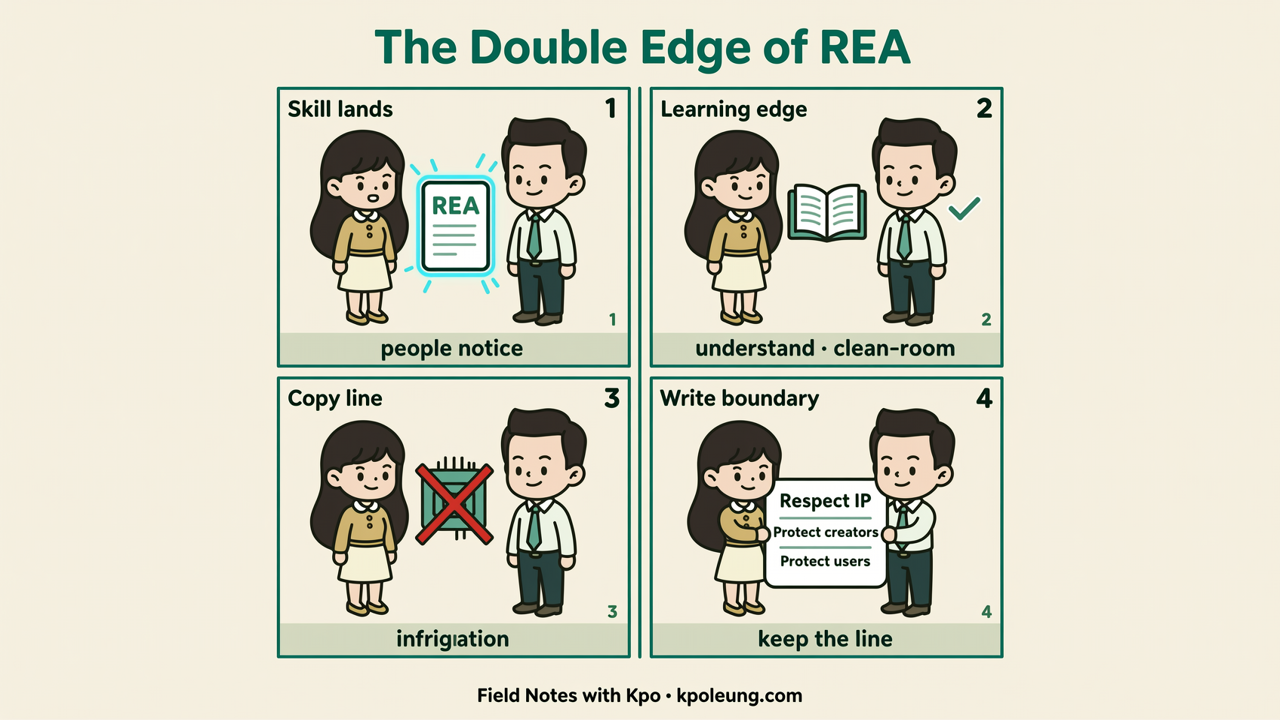
This is Part A of Field Notes 26W44-EP05. Some skills make people nervous the day they land. Reverse-engineer skills are one of them - and REA is the name a lot of people have been saying out loud. Part B - Nearby Transit Guidance on HK Ride covers open-in-maps and a simple compass toward the stop.
Hard rails first
Listeners jump straight to creative suites, office tools, CAD, video editors - the kinds of tools people worry about when a skill like this shows up. So the line comes first. We do not encourage illegal behaviour. We respect intellectual property. This note is about judgment. It is not a how-to. It will not teach reverse engineering, and it will not walk you through using REA against commercial software.
Why it feels sharp
The same capability can mean “I want to understand how a format works” - or “I want someone else’s years of product for free.” Open craft-style suites on GitHub are useful as background. They are not the point. The tool doesn’t choose the path. You do.
The learning edge
Curiosity itself isn’t a crime. Useful aims stay at the level of principle - not steps. Learn public file formats and how systems talk to each other. Compete on public specs in a clean-room way - build your own work from what is openly documented. Debug something you compiled yourself. Do security or compatibility research when you actually have permission or a contract.
The purpose is understanding - and building your own thing. Not carrying someone else’s assets out the door.
When understand becomes copy
When “understand” turns into copying an interface, the logic, the resources, the fonts, the icons - you’ve left learning. You’re in infringement territory, and you’re burning trust. That line matters more now, because an agent skill can make the wrong path feel easy.
Licences and terms of service still apply. An AI skill is not a free pass. Creators get hurt. Honest people who paid for the tools get hurt too.
Protect your own creations
If capable agent skills already exist - and they do - creators need an updated threat model. Three practical points. Not a long checklist.
First - write the boundary where people can see it. Licence terms, commercial limits, and where it fits, a clear line against reverse engineering. Put it where a human - and an agent - would actually read it.
Second - don’t put the crown jewels in the client. Secrets, proprietary model weights, unpublished algorithms - don’t assume “they can’t see it” means safe.
Third - design for the shape of the product. A pure local install and a cloud service don’t expose the same surface. Assume someone will try to take apart whatever you ship to them. Watermarks and provenance marks can help sometimes - they’re not magic.
Protect users
If you’re teaching colleagues, clients, or friends - point them at a proper licence, or at tools that are honestly open and clearly labelled. Don’t pass around “free full suite” crack links. The helpful answer is the legal path, even when it takes a minute longer to explain.
Protecting users includes protecting them from the idea that “the AI can do it” means “it’s legal.”
If I had to put Part A in one line: curiosity is fine. Copying someone’s work is not. A powerful skill still needs your judgment - the same muscle as writing a Skill with hard “do not” lines. You write the boundary. You keep it.
Continue with Part B - Nearby Transit Guidance on HK Ride. More notes are at kpoleung.com/notes/. Listen on Field Notes with Kpo (Spotify). Comments or topic requests welcome at m@kpoleung.com.
Music credits
- Intro & outro - “Teapot” by Lukrembo - https://freetouse.com/music/lukrembo/teapot
- Background bed - “At Ease” by Hazelwood - https://freetouse.com/music/hazelwood/at-ease
- License: https://freetouse.com/license