Solutions
Nearby Transit Guidance on HK Ride
This is Part B of Field Notes 26W44-EP05. Part A - The Double Edge of Reverse-Engineer Skills was about judgment when a powerful skill shows up. Part B is smaller and more concrete - a notes-page tool for getting around Hong Kong.
Distance on a list isn’t enough
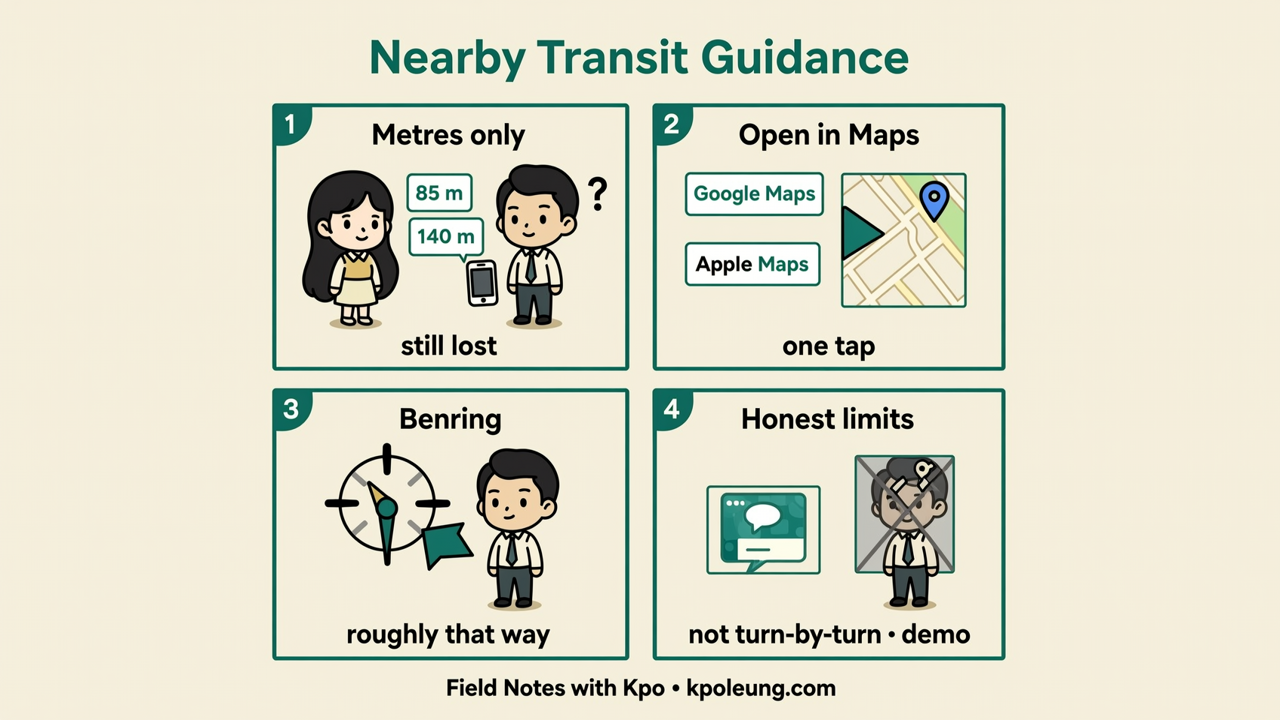
You’re near a bus stop or an MTR entrance, phone in hand. The app already shows nearby stops and how many metres away. Useful - until you look up and still don’t know which way to walk.
A number on a list doesn’t point. A pin on a map helps - but outdoors, in a hurry, you still want a clear hand-off: open the map you already trust, or a simple cue toward the stop.
What shipped
On HK Ride - my personal transit notes page, under kpoleung.com - you pick a nearby stop. You already see distance and the map. Now you can open that stop in Google Maps or Apple Maps in one tap.
And on the device itself, there’s a simple compass - a bearing toward the stop. Not a full walking tour. Just “roughly that way,” so you’re not spinning on the pavement guessing.
Nearby stops, live arrival times, search, favourites, the map - those were already there. The new piece is the hand-off and the direction cue. Small. But it’s the friction people actually feel on the street.
Why it matters
The core loop didn’t need an agent. Open transit data, a light web page, distance, a map, and a way out to the apps you already use. Judgment still matters - choosing what to build - but the everyday path is just a tool.
That’s a quiet reminder. Not every useful thing has to be wrapped in AI. Sometimes the win is fewer taps between “where am I” and “which way is the stop.”
Honest limits
The page still wears a demo banner - it’s a personal notes tool, not an official bus or MTR app. Indoors, GPS gets fuzzy. The compass needs permission, and sometimes a quick calibration, before the arrow settles.
It isn’t turn-by-turn like car navigation. It won’t replace the apps the operators ship. If the banner says imperfect, believe it. Useful on a clear day at street level - not a promise for every basement exit.
If I had to put Part B in one line: a small notes-page tool that cuts the “which way is the stop” moment - open maps when you want them, a bearing when you need a nudge - without pretending to be more than it is.
Same muscle as Part A, in a quieter key. You choose what the tool is for. You say the boundary out loud. Then people can use it without getting the wrong idea.
Read Part A - The Double Edge of Reverse-Engineer Skills for the other half of this episode. More notes are at kpoleung.com/notes/. Listen on Field Notes with Kpo (Spotify). Comments or topic requests welcome at m@kpoleung.com.
Music credits
- Intro & outro - “Teapot” by Lukrembo - https://freetouse.com/music/lukrembo/teapot
- Background bed - “At Ease” by Hazelwood - https://freetouse.com/music/hazelwood/at-ease
- License: https://freetouse.com/license