Smart for Work
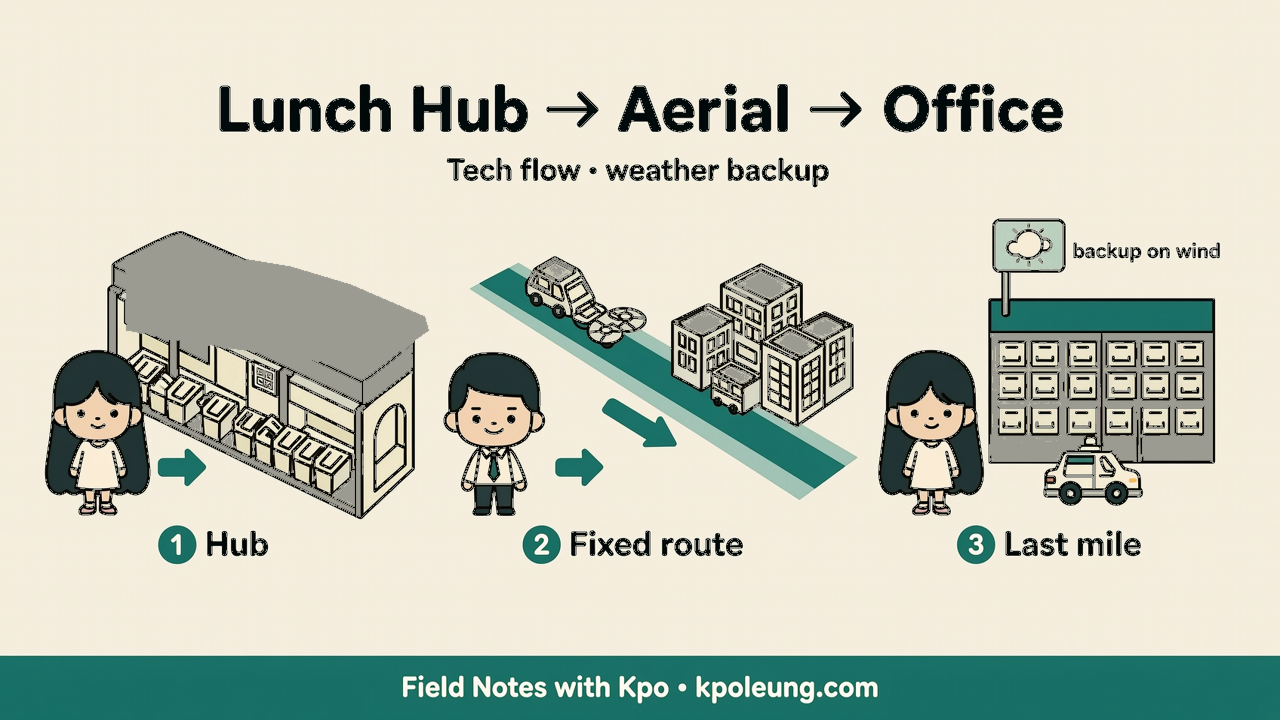
Lunch Hub → Fixed-Route Aerial → Office
This is Part A of Field Notes 26W47-EP08. Picture a weekday lunch. Roads jam. Couriers stack at the curb. Orders keep landing. The idea isn't "ban the street." It's split the trip into pieces that each do one job well.
We're talking tech flow — not who won a policy argument. Background chatter about the low-altitude economy is everywhere. Useful question for builders: what does a practical relay look like when the clock is noon and the office tower is still ten minutes of traffic away? Part B — Models Retire covers first-agent attachment when MiniMax-M2.7 gets a retirement date.
Three legs
First — shops to a lunch hub. Orders land at a collection point near the restaurants. Think simple bins or QR slots — like carriages on a train — so batches form without everyone waiting on the curb.
Second — hub to an office-cluster hub. Dispatch a drone, or another aerial platform, on a fixed route through a designated low-altitude band — fewer surprises than weaving surface traffic. The point is a timetable and a path you can brief, not a hero flight over a random street.
Third — last mile. From the office hub, a short hop by person or short-range ground vehicle to the desk. That last cut is where "wait for five more bags" usually burns time. Shorten it.
Why fixed route
Fixed route is the quiet win. Mid-volume, timed, predictable. You trade open-road improvisation for a corridor you can monitor — same path, same windows, same handoff points. Ops can brief it. Security can scan it. Weather can still veto it.
Think of it as another lane with rules, not a magic shortcut. The aerial leg only earns its keep when the first hub is already batched and the last mile is already short.
Honest bounds
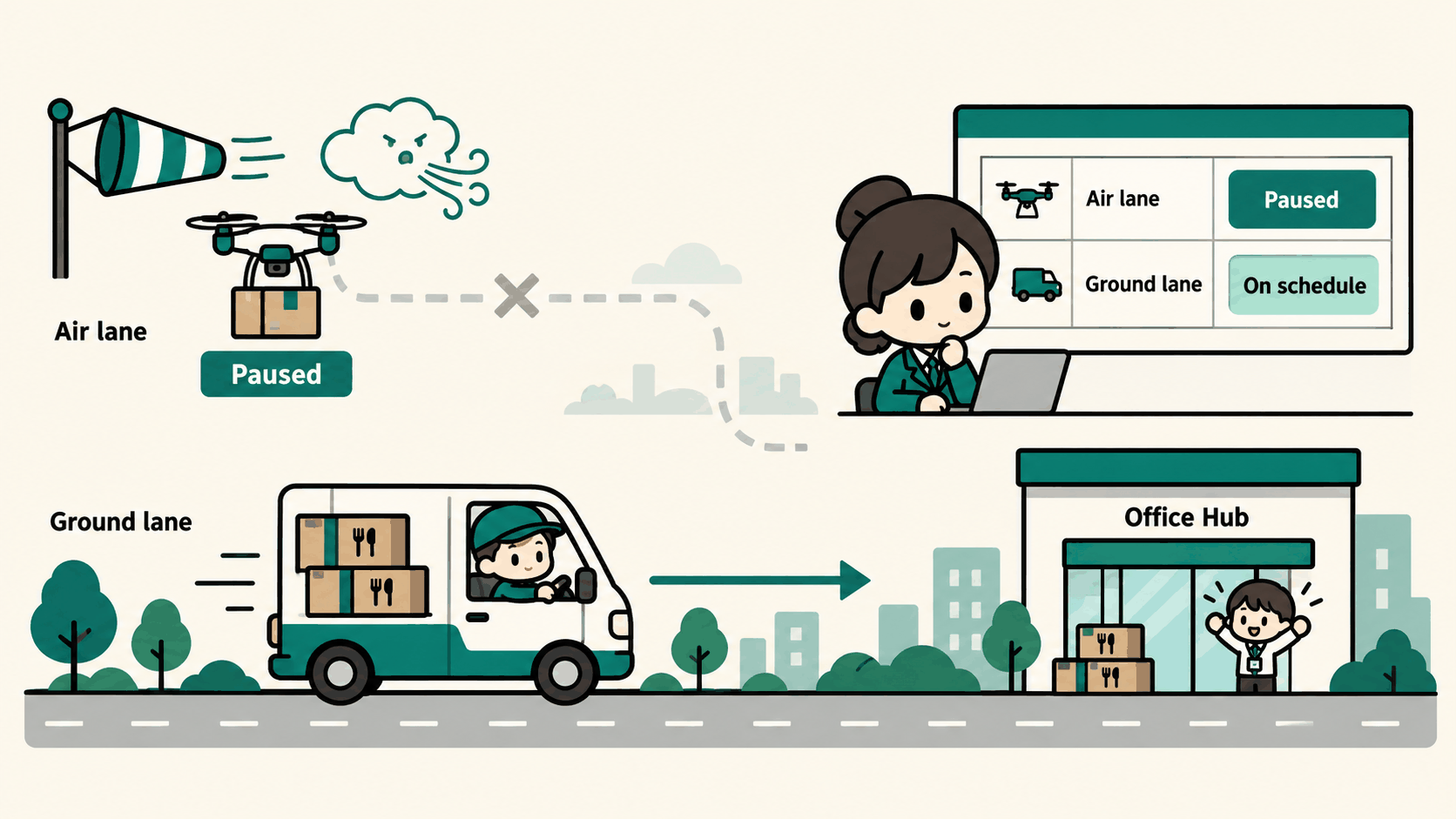
Weather still wins some days — strong wind, rain bands, typhoon signals. So you need a ground backup or a clear delay mode. Aerial isn't magic. It's capacity you use when the corridor is open and the load fits the window.
And we stay tech-flow here. No named clients. No license politics as the main line. Design the relay first. Argue the sky later.
Three quiet questions
After you read, three quiet questions — not a ranking. Where does the batch form — curb, or a real hub? Is the aerial leg on a fixed route you can brief, or still a hero path? And when weather kills the corridor, what ships the same lunch without improvising from zero?
If I had to put Part A in one line: split lunch delivery — shop to hub, fixed-route aerial to office hub, then a short last mile. Design the flow first. Argue the sky later.
Continue with Part B — Models Retire. More notes are at kpoleung.com/notes/. Podcast (English · EP08): https://open.spotify.com/episode/2MTRL4LuCKo74gkrLKZ1Sj · Podcast (粵語 · EP08-CT): 稍後上架 / coming soon. Comments or topic requests welcome at m@kpoleung.com.
Music credits — Intro & outro: “Teapot” by Lukrembo — freetouse.com/music/lukrembo/teapot · Background: “At Ease” by Hazelwood — freetouse.com/music/hazelwood/at-ease · License: freetouse.com/license