Field Feelings
Models Retire — First Agent Attachment
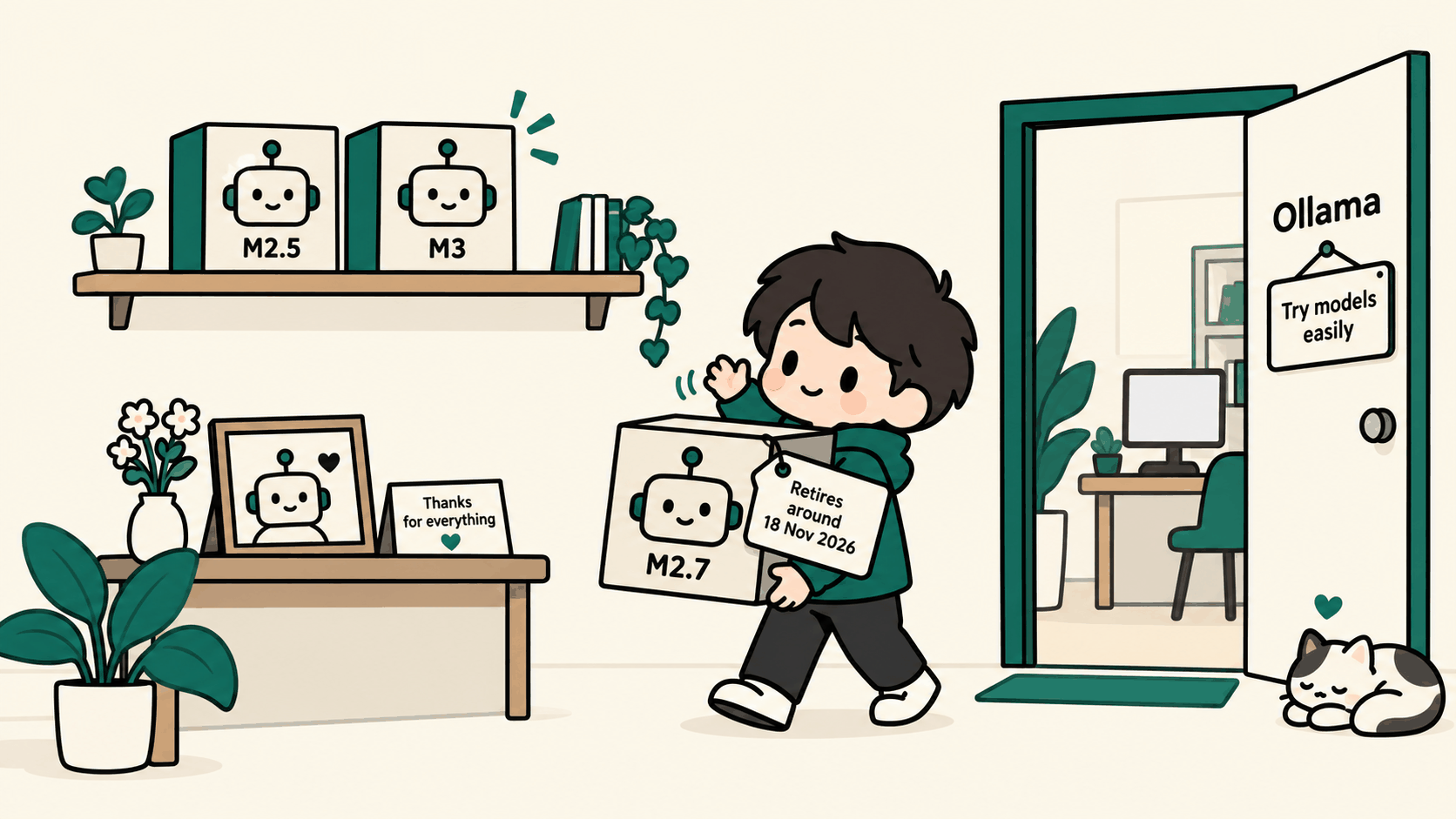
This is Part B of Field Notes 26W47-EP08. Part A — Lunch Hub → Aerial → Office was logistics in the air. Part B is quieter. A model you used as an early agent partner gets a retirement date — and something in the chest flinches.
The dates, clean
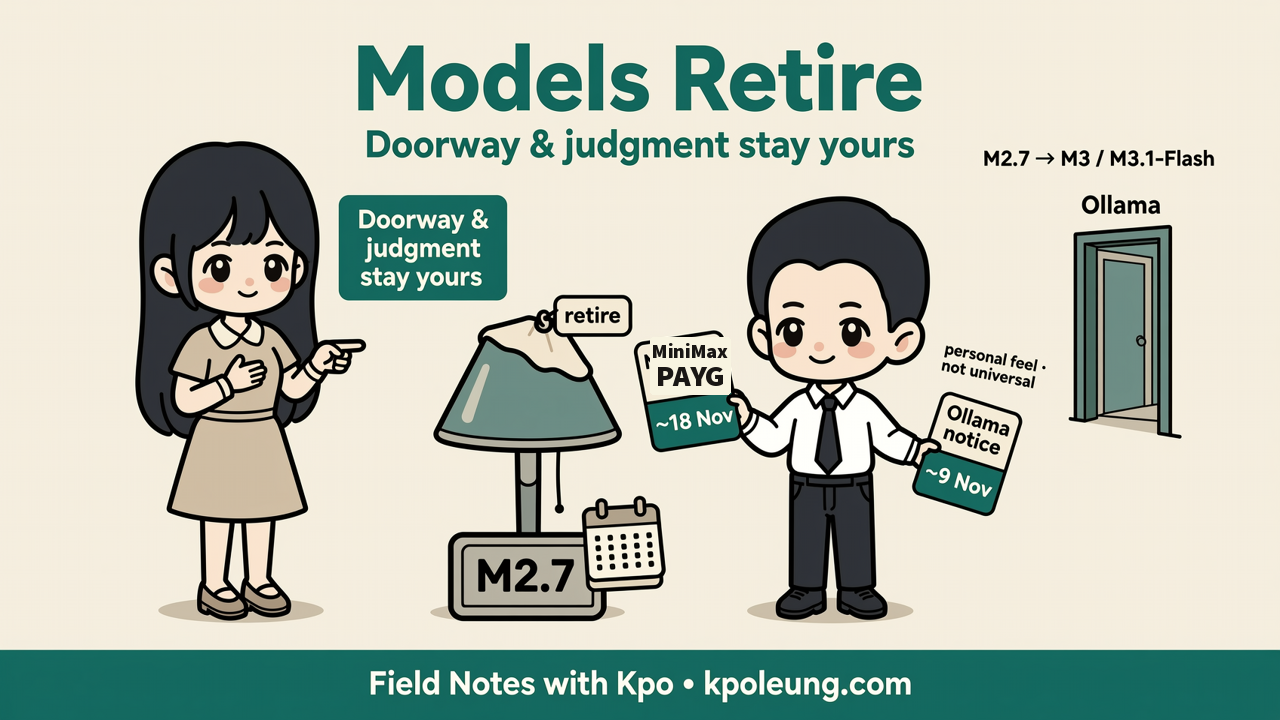
From MiniMax's own FAQ as of late October: for M2.5 and M2.7, new users were already stopped around 19 October 2026. Pay-as-you-go retirement sits around 18 November 2026. Replacements named there: MiniMax-M3 and MiniMax-M3.1-Flash — not a vague "three point oh."
Separately, I saw an Ollama-side stop notice around 9 November. Treat that as its own Usage list — it may not match the MiniMax pay-as-you-go date. Say both. Don't mash them into one rumor. And re-check the FAQ before you treat any date as gospel.
Ollama as mid-beat
Ollama is the mid-beat. For a lot of people — me included — it was the first easy doorway into shopping models for chat and text agents. Pull a model, try a prompt, swap, try again — that "browse the shelf" feeling mattered.
Strength: try many LLMs locally or near-local, cheap enough to experiment. Limit: mostly text. Fair as a first doorway into agent habits. Not as a full multimodal studio. Knowing the limit is part of keeping the doorway honest.
Feelings without fake science
So why does retirement sting? Part tool dependence — your prompts, your habits, your muscle memory live in that model. When the product line moves, your hands still reach for the old fit.
Part relationship attachment — the voice that helped you ship early agent experiments feels like "yours," even when you know it's a product line with a schedule. You're not confused about what a model is. You're noticing that early work left a mark.
You've seen a cousin of this with GPT-4o and Keep-4o energy online. Different company, same human pattern: when a familiar model leaves, people grieve the fit, not only the benchmark.
Personal label — keep it on
Personal note from the field, labeled as personal: some days M2.7 felt snappier; M3 sometimes wanders. You'll find similar talk online. That is not a universal fact. It's a feeling plus anecdotes. Keep the label on — and don't turn a vibe into a fake ranking.
Migration with eyes open
Migration with eyes open looks like this. Write the dates down — new-user stop, pay-as-you-go stop, any third-party Usage notice. Name the replacements out loud: M3, M3.1-Flash. Then re-check your habits — prompts, evals, the one workflow that used to "just work."
Feel the attachment. Don't pretend it isn't there. Then move the work, not the myth. The doorway was never one model forever — it was trying, checking, and keeping judgment when the shelf changes.
If I had to put Part B in one line: models retire. The doorway and the judgment stay yours. Feel the attachment — then migrate with eyes open: dates clear, replacements named, habits re-checked.
Same muscle as Part A. Say what the tool — or the model — is for. Say how far it goes. Then people can use the next one without getting the wrong idea.
Read Part A — Lunch Hub → Aerial → Office for the other half. More notes are at kpoleung.com/notes/. Podcast (English · EP08): https://open.spotify.com/episode/2MTRL4LuCKo74gkrLKZ1Sj · Podcast (粵語 · EP08-CT): 稍後上架 / coming soon. Comments or topic requests welcome at m@kpoleung.com.
Music credits — Intro & outro: “Teapot” by Lukrembo — freetouse.com/music/lukrembo/teapot · Background: “At Ease” by Hazelwood — freetouse.com/music/hazelwood/at-ease · License: freetouse.com/license